Concrete Repair in Belton, MO
Concrete repair for Belton — established neighborhoods to the new subdivisions and the Y Highway corridor
Concrete Repair in Belton
Concrete crack repair, spalling repair, joint sealing, and structural restoration for all concrete surfaces. Ford Concrete serves Belton, MO and the entire Kansas City metro with more than a decade of experience and a 5-star reputation.
Belton at a Glance
- Population
- 26,772
- State
- Missouri
- County
- Cass County
- Schools
- Belton School District #124
Why Belton concrete often repairs better than it replaces
Belton sits on Cass County Lagonda clay-loam, and that soil matters: clay-loam swells and shrinks less than the heavy Wymore clay north of here, so slabs move less through the seasons and more of the damage stays at the surface rather than tearing the base apart. In practice, that means a larger share of Belton concrete is genuinely repairable instead of a full replacement. We still sound the slab to confirm it before recommending a fix.
That first check — tapping for the hollow ring of delamination — tells us whether an overlay or patch will hold or just hide a failing base. Our concrete repair approach starts with the base condition, because a smooth-looking surface over a soft base fools everyone.
Active or dormant? Reading a clay-loam crack
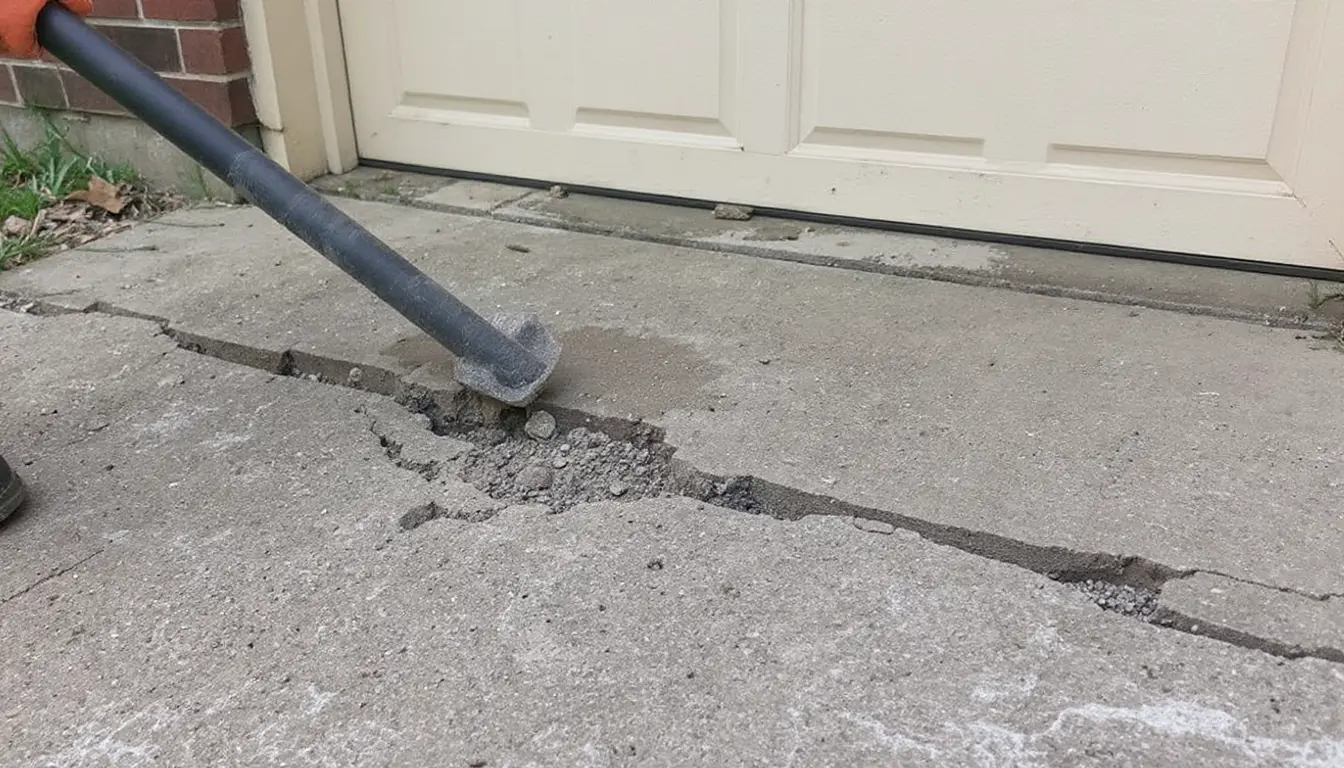
Even with less movement than heavy clay, Belton’s clay-loam still shifts enough to crack concrete, so we classify every crack as an active crack, still opening and closing, or a dormant crack before choosing a repair. Getting this right is what keeps a patch from failing.
A dormant crack in a stable panel takes a rigid structural repair that restores load across the break. An active crack over moving soil needs a flexible detail, or it reopens beside the fill within a season. A crack that has come back after a previous patch is active, whatever its width.
How a lasting repair is prepped and placed
A repair holds only if it bonds to sound concrete. We saw a clean perimeter, remove material to sound substrate, and abrade the surface to an ICRI CSP profile so the new material keys in. The weak laitance comes off, the slab is brought to a saturated surface-dry (SSD) state, and full-depth breaks get load transfer restored.
We never feather-edge a repair to a thin, unsupported border — it flakes off in a winter, and it is the most common reason a patch fails. Belton repairs go back at 4,000 PSI, air-entrained to stand up to the freeze-thaw swing Cass County sees.
New-subdivision settlement on former farmland
Belton’s newer subdivisions were built on former farmland, and where that fill was not compacted to grade, slabs settle as the ground consolidates underneath. A dropped edge or a slab that has tilted toward the house means the support is gone — and no surface repair fixes a missing base.
We probe the low edge, rebuild the substrate with compacted granular base, and reset or repour the section, then correct the grade so water runs off in line with MoDNR stormwater practice. On newer construction this is often the difference between a repair that lasts and one that sinks again the next spring.
Scaling and spalling from freeze-thaw and salt
Surface scaling that flakes the top layer off is freeze-thaw and deicer damage, worst where road salt tracks in from I-49 and Y Highway. On a sound slab it is repairable with a bonded resurfacing overlay that restores the surface without a teardown.
Left alone, scaling lets water and chloride reach the steel, corrosion starts, and expanding rust pushes the slab apart as spalling at joints and edges. Where we find exposed reinforcement, the repair means removing concrete to sound material behind the bar and cleaning the steel before rebuilding — patching over rust never holds.
Commercial lot repair along Y Highway
The retail lots around Belton Town Center and the Y Highway corridor show wear as blown joints and pothole development under steady traffic. Those repair well when the joint detail and load transfer are rebuilt, not just when the visible hole is filled.
The crew that repairs a retail-lot joint pours residential drives in the same subdivisions, and the standard holds across both. See the range on our commercial concrete page, and compare nearby work in Raymore and Grandview.
What concrete repair costs in Belton — and when to replace
We price from the cause, not the crack, so the number follows a real look at the slab and base — never a phone quote. Because clay-loam is gentler on concrete, Belton slabs are often repairable at a lower cost than comparable damage on heavy clay. But when settlement or corrosion has worked through most of a slab, replacement wins over a decade, and we tell you that.
You get a written figure and a clear repair-or-replace call. Structural and right-of-way work runs through the City of Belton Community Development department; the details are in our permits guide. KC-metro homeowners rate Ford 4.9 stars across 29 reviews for exactly this kind of straight answer.
Cracked or settling concrete in Belton?
From call to concrete — the fastest in KC.
On Cass County clay-loam, more damage is repairable than you might expect — but only a real look tells you. We sound the slab, find the cause, and hand you a written repair-or-replace answer, usually within 24 hours. Call (816) 721-1699.
Belton Concrete Repair, done to spec
Sound the slab and classify the damage
We tap for delamination, gauge how deep the damage runs, and mark each crack active or dormant.
Remove to sound concrete
Deteriorated material is saw-cut to a clean edge and taken back to sound substrate — no feather-edges, no patching over rust.
Prep for bond or rebuild the base
We abrade to an ICRI profile, reach saturated surface-dry, and where a slab settled, rebuild the granular base and correct drainage.
Place air-entrained and cure
We overlay or pour back at 4,000 PSI, air-entrained for Cass County winters, restore load transfer, and cure the repair.
Warning signs on Belton Concrete Repair
Isolated surface cracks
On clay-loam, damage often stays at the surface — a good sign the slab is repairable rather than failing.
A slab tilted toward the house
Settlement on uncompacted subdivision fill means lost support and a void that has to be rebuilt first.
Surface flaking away
Scaling that sheets the top layer off is freeze-thaw and deicer damage, worst near I-49 and Y Highway.
Spalling with rust at joints
Edge and joint breaks with brown staining mean salt has reached the steel and corrosion is underway.
Blown joints on a commercial lot
Broken joints under traffic along Y Highway need load transfer restored, not just the hole filled.
How Ford earns Belton work
We know the local soil
Cass County clay-loam moves less than heavy clay, so more Belton damage stays repairable. We confirm it by sounding the slab first.
Every crack classified
Even gentler soil moves enough to crack concrete. We read each crack active or dormant so the repair does not fail beside the fill.
Settlement fixed at the base
On new subdivisions over former farmland, we rebuild the base and correct drainage — not just skim the surface that sank.
A straight repair-or-replace answer
You get a written figure and an honest call on which way to go. Rated 4.9 stars across 29 reviews.
Commercial work behind our Belton crews
From your driveway to an Amazon warehouse — the same crew, the same standards, every project.
Taco Bell
New Construction
Overland Park, KS
Domino's Pizza
New Construction
Independence, MO
Freddy's
New Construction
Kansas City
Tidal Wave Car Wash
New Construction
Kansas City
Amazon
New Construction
Riverside, MO
Nortian Food Grade Protein Facility
New Construction
Springfield, MO
Book your Belton Concrete Repair estimate
Or call us directly: (816) 721-1699
Concrete Repair in Belton — FAQs
Is Belton concrete easier to repair than concrete farther north?
My new subdivision driveway is already settling — why?
Why do my cracks keep coming back after patching?
My concrete is spalling and I can see rebar — can it be patched?
Do I need a permit to repair concrete in Belton?
Related concrete services in Belton
Nearby Belton-area projects
Let's build your Belton Concrete Repair
From call to concrete — the fastest in KC.
Get a free, no-obligation estimate for your concrete project. We serve the entire Kansas City metro — call (816) 721-1699 or request your estimate online.