
Warehouse & Industrial Floors in Leavenworth, KS
Warehouse and industrial floors for Leavenworth's 4th Street corridor and Business & Industrial Park — built on ground that stays strong only as long as it stays dry.
Warehouse & Industrial Floors in Leavenworth
High-performance industrial concrete floor installation for warehouses, distribution centers, and manufacturing facilities. Ford Concrete serves Leavenworth, KS and the entire Kansas City metro with more than a decade of experience and a 5-star reputation.
Leavenworth at a Glance
- Population
- 37,015
- State
- Kansas
- County
- Leavenworth County
- Schools
- Leavenworth Public Schools (USD 453)
Why a Leavenworth floor is only as strong as the ground stays dry
A warehouse floor in Leavenworth is a water-management problem before it is a concrete problem. The wind-laid silt under the bluffs carries load well while dry and loses strength when it wets, so we cut the water off first — grading, drainage, and a sealed vapor retarder — then build the slab on a base with no reason to get wet.
That makes this corner of the metro behave unlike the clay ground east of the river. Jackson County clay takes on water, swells, and shoves a slab upward. The silt along the bluffs above Leavenworth Landing does the opposite: saturate it and it consolidates, and the floor drops. Downward is the harder failure to live with, because the slab is left spanning a void it was never designed to span, and it cracks on the way down.
The buildings that show it are the older ones. Much of the commercial and institutional stock here goes back to the mid-twentieth century, and the industrial ground off Metropolitan Avenue and the 4th Street corridor has had sixty years of heavy delivery and equipment traffic to find every soft spot. When a floor has dropped in one patch and stayed true everywhere else, the concrete is almost never the reason.
Where the water actually gets in
Roof drainage is the first suspect. A downspout discharging at the building line puts thousands of gallons a year into the ground a few feet from the slab edge, and in this silt that alone can take a corner down. We want it piped away from the building before we start caring about mix designs.
The second suspect runs underground: a leaking floor drain, a cracked sanitary line, a cooler condensate line. Those wet the base from below, quietly, for years. When a floor here has settled in an area that makes no sense against the traffic pattern, we go looking for a pipe before we go looking for a design flaw. It is the single most useful thing to check in an older Leavenworth building, and almost nobody checks it first.
The rest is build sequence. Grade so surface water leaves the site, proof-roll the exposed subgrade and correct soft ground instead of bridging over it, compact the base in lifts, and run the vapor retarder directly against the underside of the slab. Set it lower, under a granular layer, and that layer becomes a reservoir sitting in ground we spent the whole project trying to keep dry.
Flat and jointed for the trucks the 4th Street corridor sends
Leavenworth's industrial buildings mostly are not high-bay distribution centers, and pretending otherwise costs owners money. These are manufacturing, service, storage, and institutional support floors — heavy traffic, low racking. That is random traffic, not defined traffic, so it gets specified with overall FF/FL numbers taken to ASTM E1155, and there is no reason to buy the tight tolerances a VNA aisle would need.
The joints take the punishment instead. We put in an early saw cut so the slab cracks where we chose rather than where it wants to, set a dowel basket at construction joints so a loaded axle transfers across the joint instead of hammering one unsupported edge, and armor the joint on the dock impact line where the heaviest wheels land. Joint filler goes in after the slab has done most of its shrinking, which is later than most schedules would like and is the reason filler stays put.
Leavenworth permits and the floors behind our name
We pull City of Leavenworth permits, work to KDHE site rules, and keep the schedule around your operation. For proof: Ford Concrete has poured new-construction industrial floors for Amazon in Riverside and the Nortian food-grade protein facility in Springfield — neither is a Leavenworth job, but both are the real thing — and KC-metro property owners rate us 4.9 stars across 29 reviews. Look through the gallery, our commercial concrete work, and how we run jobs with general contractors. We pour the same floors in Lansing, Basehor, and Tonganoxie. The service page is here, and the Kansas City soil conditions guide covers what sits under the Leavenworth corridor.
Floor dropping in one spot?
From call to concrete — the fastest in KC.
That is usually water, and water has a source. We will walk the building, find it, and tell you what the floor needs. Call (816) 721-1699 for a Leavenworth site visit.
How we build Warehouse & Industrial Floors that lasts in Leavenworth
Follow the water
Roof discharge, site grade, floor drains, and buried lines — we find what is wetting the ground.
Proof-roll the subgrade
We load the exposed ground and watch it. Anything that pumps or deflects gets corrected, not covered.
Build the base in lifts
Compacted in controlled layers so the floor is bearing on the base rather than resting on it.
Seal the retarder to the slab
The vapor retarder goes tight against the slab underside, with no granular layer above it to hold water.
Cut, dowel, and armor
Early saw cuts, dowel baskets for load transfer, armored joints on the dock impact lines.
When Warehouse & Industrial Floors in Leavenworth is ready to replace
One area of floor sitting low
Silt under that patch got wet and consolidated. The slab is now spanning ground that quit supporting it.
Cracks that fan out from a low spot
The slab is bending into a void. That pattern points at the base, not at the concrete.
Joint edges chipping under hard wheels
Load is not transferring across the joint, so every crossing wheel drops onto an unsupported edge.
Damp slab that will not take a coating
Water is still moving up through the slab from a base that never got cut off from the ground.
Why Leavenworth homeowners call Ford
Water first, concrete second
We fix roof discharge and site grade before we design a slab, because in this ground that is the slab.
We look for the pipe
Localized settlement in an older building is often a leak under the floor, not a bad pour.
Soft ground gets corrected
We proof-roll the subgrade and fix what fails rather than bridging over it with more base.
Specified to the building you have
Storage and service floors get storage and service tolerances — we do not sell distribution numbers.
Where our Warehouse & Industrial Floors crews have delivered
From your driveway to an Amazon warehouse — the same crew, the same standards, every project.
Taco Bell
New Construction
Overland Park, KS
Domino's Pizza
New Construction
Independence, MO
Freddy's
New Construction
Kansas City
Tidal Wave Car Wash
New Construction
Kansas City
Amazon
New Construction
Riverside, MO
Nortian Food Grade Protein Facility
New Construction
Springfield, MO
Get your free Warehouse & Industrial Floors estimate in Leavenworth
Or call us directly: (816) 721-1699
Warehouse & Industrial Floors in Leavenworth — FAQs
Why does a Leavenworth floor settle instead of heave?
Our floor dropped in one corner of the building. Does the whole slab come out?
How flat does a Leavenworth warehouse floor need to be?
More Leavenworth concrete services
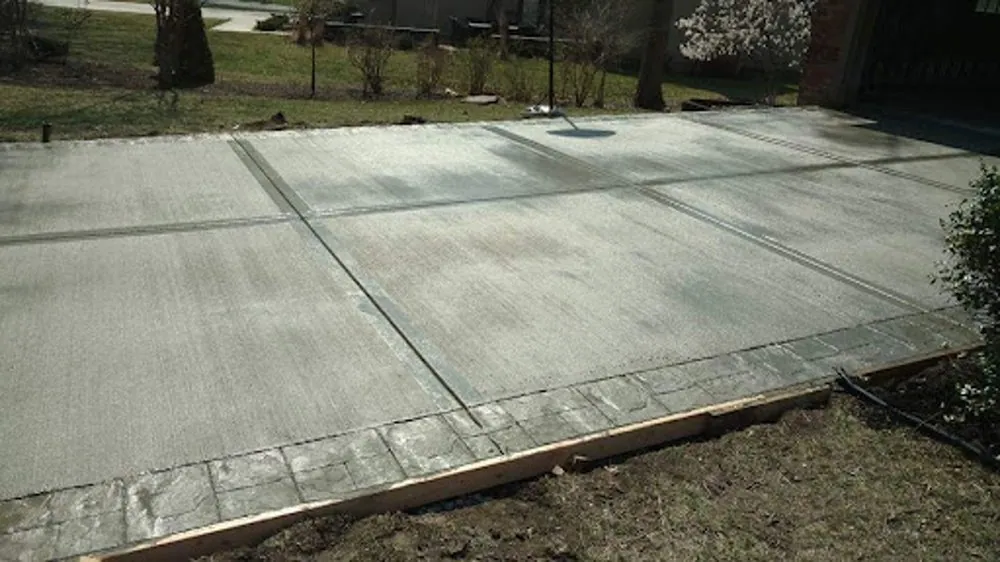
Warehouse & Industrial Floors across the Leavenworth County area
Ready to pour in Leavenworth?
From call to concrete — the fastest in KC.
Get a free, no-obligation estimate for your concrete project. We serve the entire Kansas City metro — call (816) 721-1699 or request your estimate online.