
Warehouse & Industrial Floors in Louisburg, KS
Pre-engineered building floors along US-69 and K-68, poured when the weather says they should be — not when the schedule wishes they were.
Warehouse & Industrial Floors in Louisburg
High-performance industrial concrete floor installation for warehouses, distribution centers, and manufacturing facilities. Ford Concrete serves Louisburg, KS and the entire Kansas City metro with more than a decade of experience and a 5-star reputation.
Louisburg at a Glance
- Population
- 4,955
- State
- Kansas
- County
- Miami County
- Schools
- Louisburg USD 416
The floor usually goes in before Louisburg's building has walls
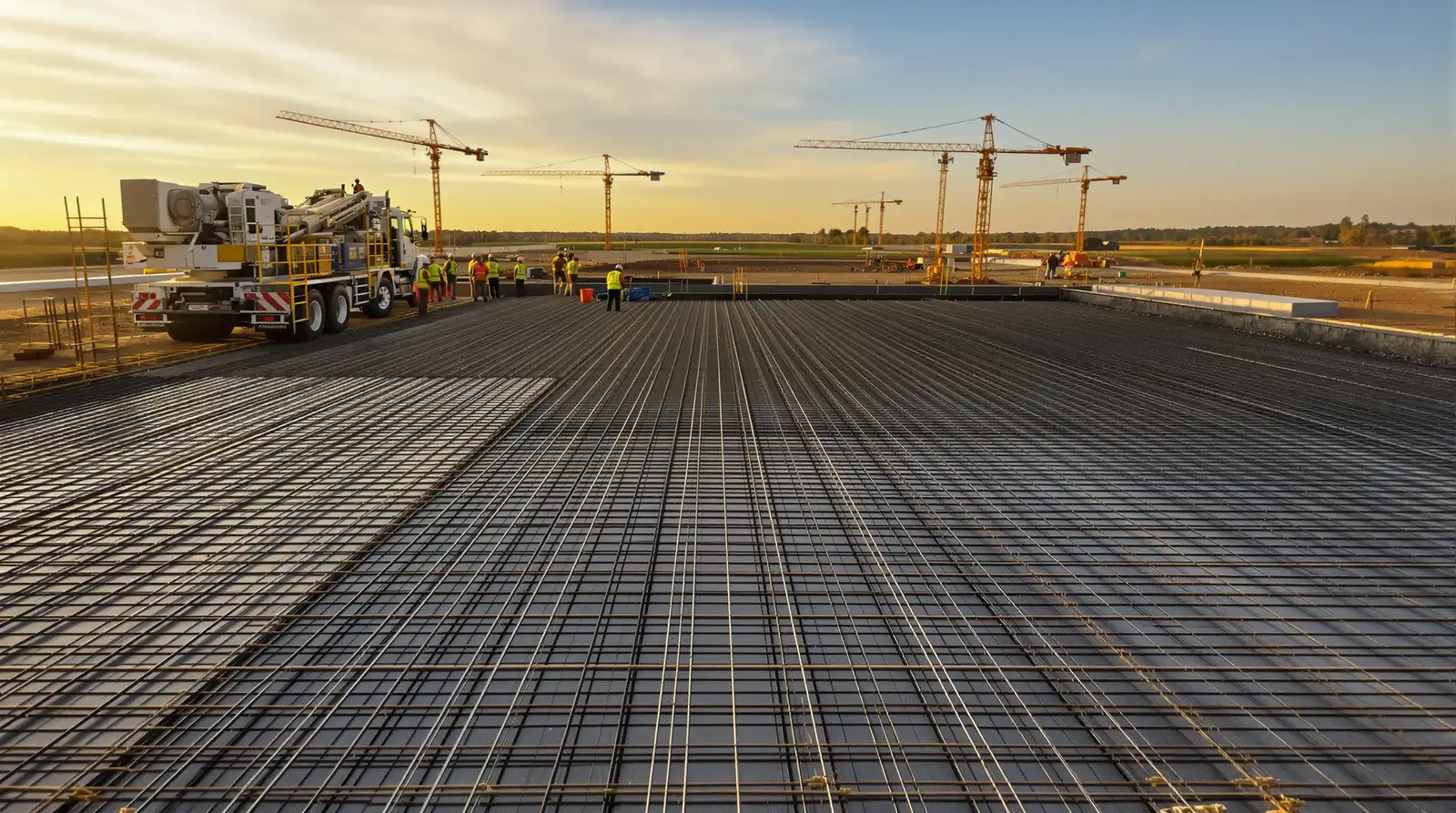
In Louisburg, the slab often goes down inside a bare steel frame before the walls and roof are closed in. That is a real choice, not a default. We decide it on wind, sun, and evaporation rate rather than the calendar, and if the numbers say the surface will dry faster than it can bleed, we wait.
Most industrial buildings around the Louisburg Industrial Park and the US-69 interchange are pre-engineered metal. Steel goes up fast, and the schedule wants the floor in early so the other trades can work off it. Pouring early is frequently the right call. Pouring early without controlling the weather is how you buy a floor that crazes and dusts in its first year.
An open frame is a wind tunnel. Sun heats the deck, wind strips moisture off the surface, and the top of the slab shrinks while the bottom has not moved yet. What you get is plastic shrinkage cracking — thin, random surface cracks that show up before the concrete has set, and that no joint filler or saw cut pattern can undo, because they had nothing to do with the joints.
What actually cracks a slab that day: wind, not heat
Contractors blame heat. The real trigger is evaporation rate — how fast water leaves the surface — and it is driven as much by wind speed and humidity as by temperature. ACI 305 puts the warning line at roughly 0.2 pounds per square foot per hour. A 70-degree day with a 20 mph south wind across an open frame crosses it; a still 90-degree day may not.
A surface that dries out that early never develops the density it was designed for, and its abrasion resistance is gone before the first forklift arrives. There is no repair short of a topping. So we run the numbers before the trucks roll, and we have four moves when they come back high.
Hang temporary windbreaks across the open bays. Move the pour to a night or early-morning start. Fog the surface and use an evaporation retarder between finishing passes. Or wait until the building is closed in — the only option that costs schedule, and the only one that is sometimes still right. If the floor is getting a dry-shake hardener, that option moves up the list, because a hardener needs bleed water the wind has not already taken.
Miami County clay under the US-69 corridor
Louisburg's ground is heavy, poorly drained clay — Miami County dirt that holds water long after a rain and gives it back slowly. That matters less for bearing than for moisture. A floor here sits on a subgrade that is rarely fully dry, under a roof that will not let it dry downward.
So the vapor retarder goes tight under the concrete, seams lapped and taped, every penetration sealed. Then F2170 RH probes tell us when the slab is genuinely dry enough to coat, which on this ground lands later than the schedule assumes. We proof-roll the subgrade before any of it and dig out soft spots instead of bridging them with base rock.
Frost depth in Miami County runs about 34 inches. Footings, dock leveler pits, and any thickened edge tied to this floor get set below that line, and they get isolated from the slab so the two can move on their own schedules.
Getting a Louisburg floor permitted and poured
Louisburg processes permits through City Hall and approvals are straightforward for a city its size. One thing worth knowing before you plan an addition: the zoning code requires off-street parking to be surfaced when a building expands, so the floor inside is rarely the only concrete a project needs. Stormwater on the Kansas side answers to KDHE.
More than a decade pouring across the KC metro is the record behind our crews. Our commercial new construction — Amazon in Riverside, the Nortian food-grade protein facility in Springfield — shows the scale we work at. Neither is a Louisburg job, and we would rather say so than blur it. KC-metro clients rate us 4.9 stars across 29 reviews.
Look through the gallery, our commercial concrete work, and how we run jobs for general contractors. Our Kansas City soil conditions guide covers the ground under all of it. We also pour warehouse floors in Paola, Spring Hill industrial slabs, Olathe floors, and Gardner floors. Service page: warehouse and industrial floors.
Building on US-69?
From call to concrete — the fastest in KC.
Tell us where the steel is and when you need the floor, and we will give you a straight answer on whether to pour open or wait for the envelope. Free estimate.
What goes into a Louisburg Warehouse & Industrial Floors job
Look at the building, not just the pad
Whether the frame is open or closed changes the whole plan. We need to know what the slab will be exposed to on pour day.
Run the weather numbers
Wind, humidity, and temperature give us an evaporation rate. That number decides whether we pour, protect, or postpone.
Proof-roll the clay
Miami County subgrade gets compacted and proof-rolled. Soft spots come out. Base rock does not fix wet ground, it just hides it for a season.
Set the vapor retarder
Tight to the underside of the slab, seams lapped and taped, penetrations sealed. Once concrete covers it, nobody touches it again.
Place with the protection already on site
Windbreaks, fog equipment, and evaporation retarder are staged before the first truck, not sent for after the surface starts tearing.
Cure it, cut it, and test it
Wet cure, saw cuts on time, and RH probes before anything gets coated. Joint filler goes in after shrinkage, not on the punch list.
When Warehouse & Industrial Floors in Louisburg is ready to replace
A fine web of cracks that appeared almost immediately
Plastic shrinkage cracking shows up within hours of the pour. It means the surface lost water faster than the slab could bleed it — wind, usually, not heat.
The floor dusts under traffic
Chalk under a forklift tire means a weak surface layer. Concrete that dried out before it set never built the density it was specified for.
Coatings that will not stick
On Miami County clay, moisture pushing up from a subgrade that never dries is the usual culprit. The product is rarely the problem.
Slab edges lifting near the doors
Where a slab is restrained by a footing set at frost depth but was not isolated from it, something has to give. Usually it is the concrete.
Why Ford for your Louisburg Warehouse & Industrial Floors
We pour to a number, not a hunch
Wind speed, humidity, air and concrete temperature go into an evaporation rate before the trucks roll. If it is over the line, we change the plan and tell you why.
We will recommend waiting
Sometimes the right answer is to pour after the building is closed in. That costs schedule and we will still say it, because a crazed surface costs more.
Metal-building floors are their own animal
Pre-engineered frames along US-69 put the slab in before the envelope. We plan for an open building instead of pretending it is a closed one.
Miami County clay gets respected
Slow-draining ground means a permanent moisture source under your floor. The vapor retarder and the RH numbers are not optional here.
Proof we pour at any scale
From your driveway to an Amazon warehouse — the same crew, the same standards, every project.
Taco Bell
New Construction
Overland Park, KS
Domino's Pizza
New Construction
Independence, MO
Freddy's
New Construction
Kansas City
Tidal Wave Car Wash
New Construction
Kansas City
Amazon
New Construction
Riverside, MO
Nortian Food Grade Protein Facility
New Construction
Springfield, MO
Price your Louisburg Warehouse & Industrial Floors project
Or call us directly: (816) 721-1699
Warehouse & Industrial Floors in Louisburg — FAQs
Should we pour the floor before the metal building is closed in?
Why does Miami County clay matter if the building has a roof over it?
Does Louisburg require anything unusual for an industrial expansion?
More Louisburg concrete services
Nearby Louisburg-area projects
Start your Louisburg concrete project
From call to concrete — the fastest in KC.
Get a free, no-obligation estimate for your concrete project. We serve the entire Kansas City metro — call (816) 721-1699 or request your estimate online.