
Warehouse & Industrial Floors in Overland Park, KS
Industrial concrete floors for Overland Park — Johnson County clay-loam prepped right, poured to an FF/FL flatness spec, and jointed for the traffic the building will actually run.
Warehouse & Industrial Floors in Overland Park
High-performance industrial concrete floor installation for warehouses, distribution centers, and manufacturing facilities. Ford Concrete serves Overland Park, KS and the entire Kansas City metro with more than a decade of experience and a 5-star reputation.
Overland Park at a Glance
- Population
- 205,413
- State
- Kansas
- County
- Johnson County
- Schools
- Blue Valley, Shawnee Mission, and Olathe Public Schools
What makes a warehouse floor last in Overland Park?
A warehouse floor lasts in Overland Park when the subgrade is prepped for Johnson County's clay-loam, the slab is poured to a defined flatness number, and the joints are built for the traffic. On moderately expansive clay-loam that means a compacted subbase, a vapor retarder, and a slab thickness sized to the rack load the racks will put down.
Overland Park runs everything from flex space and last-mile distribution along the Metcalf and College Boulevard corridors to the newer commercial ground around Bluhawk. Each of those buildings asks a different question of the floor, and the answer starts underground and ends at the joints. Ford builds to the structural spec, not a generic slab.
Prepping Johnson County clay-loam under the slab
Overland Park's Martin-Woodson clay-loam has moderate expansion potential — milder than the heavy clays east of State Line, but it still shrinks and swells with moisture. A slab riding directly on that subgrade moves with it, and a moving subgrade drives curling and cracking. We proportion and moisture-condition a compacted subbase so the slab sits on a stable, uniform platform instead of the raw clay.
That subgrade work is where a floor is won or lost, and it is the same reading we lay out in our soil-conditions guide. Get it right and the rest of the floor — flatness, joints, surface — has firm ground to perform on.
The vapor retarder and the moisture test before coatings
Any warehouse floor that will carry a coating, a covering, or a sealer needs the moisture blocked and then proven. A vapor retarder goes directly under the slab so ground moisture can't drive up into the concrete, and before anything is applied to the surface we run the F2170 relative-humidity test.
Skipping that test is how coatings blister and peel months after the building opens. On Johnson County clay-loam, with its seasonal moisture swing, proving the slab dry from the inside is the difference between a floor that holds its finish and one that has to be redone.
How flat does an Overland Park warehouse floor need to be?
Flatness is not one number — it is the number your operation needs. We measure it as FF/FL face-flatness and levelness values under ASTM E1155, so the target is testable and the floor is verified against it. The right target depends on how the building runs.
A random-traffic distribution floor, where forklifts travel in no fixed pattern, is specified with overall FF/FL numbers. A defined-traffic floor — a VNA very-narrow-aisle building where wire-guided trucks lift loads three and four levels up a fixed aisle — needs far tighter, direction-specific flatness in those aisles. We set the spec to the equipment and pour to it.
Joints: where a hard-wheel floor fails first
More warehouse floors fail at the joints than anywhere in the field, because that is where hard wheels hit an edge. We control it three ways. Contraction joints are saw-cut on time, before the slab cracks on its own. Construction joints get a dowel basket so load transfers across the joint instead of pounding one edge.
At the heaviest-traffic lines we set an armored joint — steel-plate edges that take the wheel impact — and every joint is filled with a semi-rigid joint filler that backs the concrete edge. Built that way, the joints carry the traffic instead of spalling under it.
Controlling curl before the racks go in
Curling is the slab lifting at its edges as the top dries and shrinks faster than the bottom. Left alone, a curled edge becomes a joint that hammers under every wheel and a rack post that no longer sits flat. We control it with a sound water-cement ratio, proper curing, joint spacing sized to the slab, and the vapor retarder that keeps the moisture gradient from getting worse.
Getting curl under control before the racking and equipment go in is far cheaper than grinding it out afterward, which is why it is designed into the pour, not chased later.
A surface that takes forklift wear
The top of an industrial floor takes the abrasion of steel and poly wheels, turning, and dragged loads, day after day. Where the traffic warrants it we broadcast a dry-shake hardener into the fresh surface, building a dense, wear-resistant top that outlasts a plain troweled finish.
Matching the surface to the duty — a heavy dry-shake floor for a high-throughput distribution building, a hard-troweled surface for lighter flex space — keeps you from over-building a light floor or under-building a hard-run one.
OP codes, and the floors behind our name
Overland Park permits and inspects commercial concrete through its Planning and Development department, and Johnson County's largest city runs a thorough process — we build to the FF/FL spec and the structural drawings. Ford poured the Taco Bell here in Overland Park, and at warehouse scale the same crews placed the fulfillment-center floor for Amazon in Riverside and the Nortian food-grade protein facility. Overland Park property owners get that standard, backed by a 4.9-star rating across 29 reviews. Call (816) 721-1699, see our commercial work, the gallery, or how we run scope for general contractors. Warehouses near Lenexa and Olathe get the same build.
Planning an industrial floor in Overland Park?
From call to concrete — the fastest in KC.
From clay-loam subgrade to a defined flatness spec and armored joints, Ford builds the floor to the way your building will actually run. Call (816) 721-1699 to set up a site visit.
What goes into an Overland Park Warehouse & Industrial Floors job
Read the subgrade and the use
We evaluate the clay-loam and how the building will run — random traffic or defined-aisle — before we set the spec.
Build the subbase
A compacted, moisture-conditioned subbase gives the slab a stable, uniform platform over the expansive clay.
Vapor retarder and reinforcement
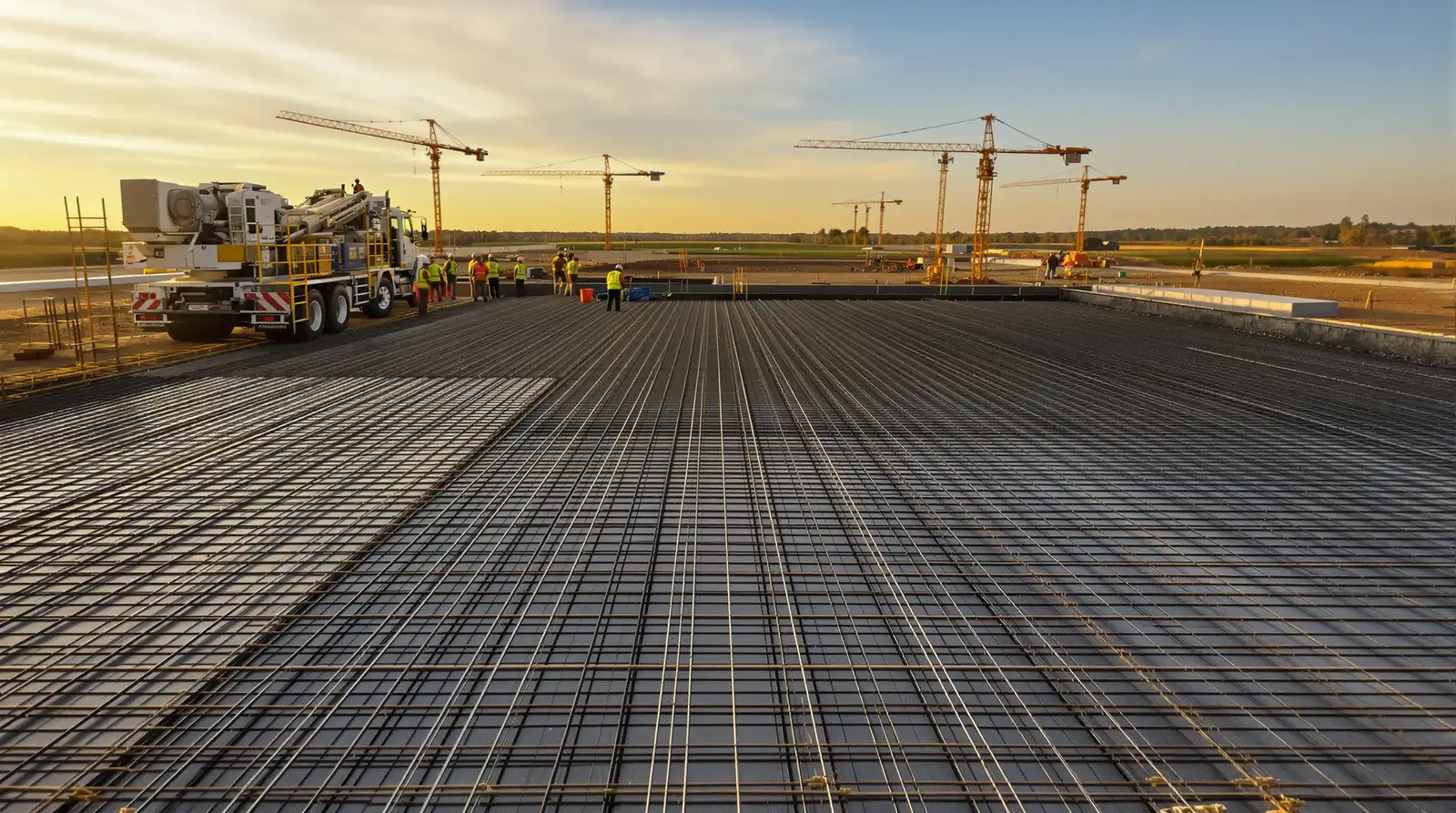
Poly goes down under the slab, and steel and thickness are sized to the rack loads.
Place to the flatness spec
The slab is placed and finished to the FF/FL number the operation and equipment require.
Harden the surface
Where the duty calls for it, a dry-shake hardener is broadcast into the fresh surface for abrasion resistance.
Joint, cure, and test
We saw-cut and dowel the joints, cure to control curl, and run F2170 before any coating goes down.
Is your Overland Park Warehouse & Industrial Floors failing?
Cracking that tracks the subgrade
Random field cracking over clay-loam usually means the slab is riding a moving subgrade instead of a stable subbase.
Curled, lifting edges
Edges rising at the joints are curling from a moisture gradient the vapor retarder and cure should have controlled.
Coatings peeling and blistering
A finish lifting months in is trapped moisture — the slab was coated before an F2170 test proved it dry.
Spalling at the joints
Chipped joint edges under forklift traffic show joints built without load transfer, armor, or a semi-rigid filler.
Racks sitting out of level
Posts that will not shim flat sit on a floor poured without a real FF/FL flatness target.
Surface dusting and wear
A field that dusts and wears fast lacks the dry-shake hardener a high-traffic floor needs for abrasion resistance.
The Ford difference on Overland Park Warehouse & Industrial Floors
Clay-loam prepped right
We proportion and moisture-condition a compacted subbase so the slab sits on a stable platform, not raw expansive clay-loam.
Poured to a flatness number
FF/FL flatness measured under ASTM E1155 makes the spec a real, verified target instead of a guess.
Joints built for the wheels
Saw-cut contraction joints, dowel-basket load transfer, armored edges, and semi-rigid filler keep the joints from failing first.
Proven at warehouse scale
The crew behind the Amazon Riverside floor and the Nortian food-grade facility pours your Overland Park slab.
Proof we pour at any scale
From your driveway to an Amazon warehouse — the same crew, the same standards, every project.
Taco Bell
New Construction
Overland Park, KS
Domino's Pizza
New Construction
Independence, MO
Freddy's
New Construction
Kansas City
Tidal Wave Car Wash
New Construction
Kansas City
Amazon
New Construction
Riverside, MO
Nortian Food Grade Protein Facility
New Construction
Springfield, MO
Price your Overland Park Warehouse & Industrial Floors project
Or call us directly: (816) 721-1699
Warehouse & Industrial Floors in Overland Park — FAQs
What flatness spec does my Overland Park warehouse floor need?
How do you keep a floor from cracking over Johnson County clay?
Why run an F2170 test before coating the floor?
What are armored joints and do I need them?
What is a dry-shake hardener for?
Who has Ford built industrial floors for?
Other concrete work we do in Overland Park
Nearby Overland Park-area projects
Start your Overland Park concrete project
From call to concrete — the fastest in KC.
Get a free, no-obligation estimate for your concrete project. We serve the entire Kansas City metro — call (816) 721-1699 or request your estimate online.