
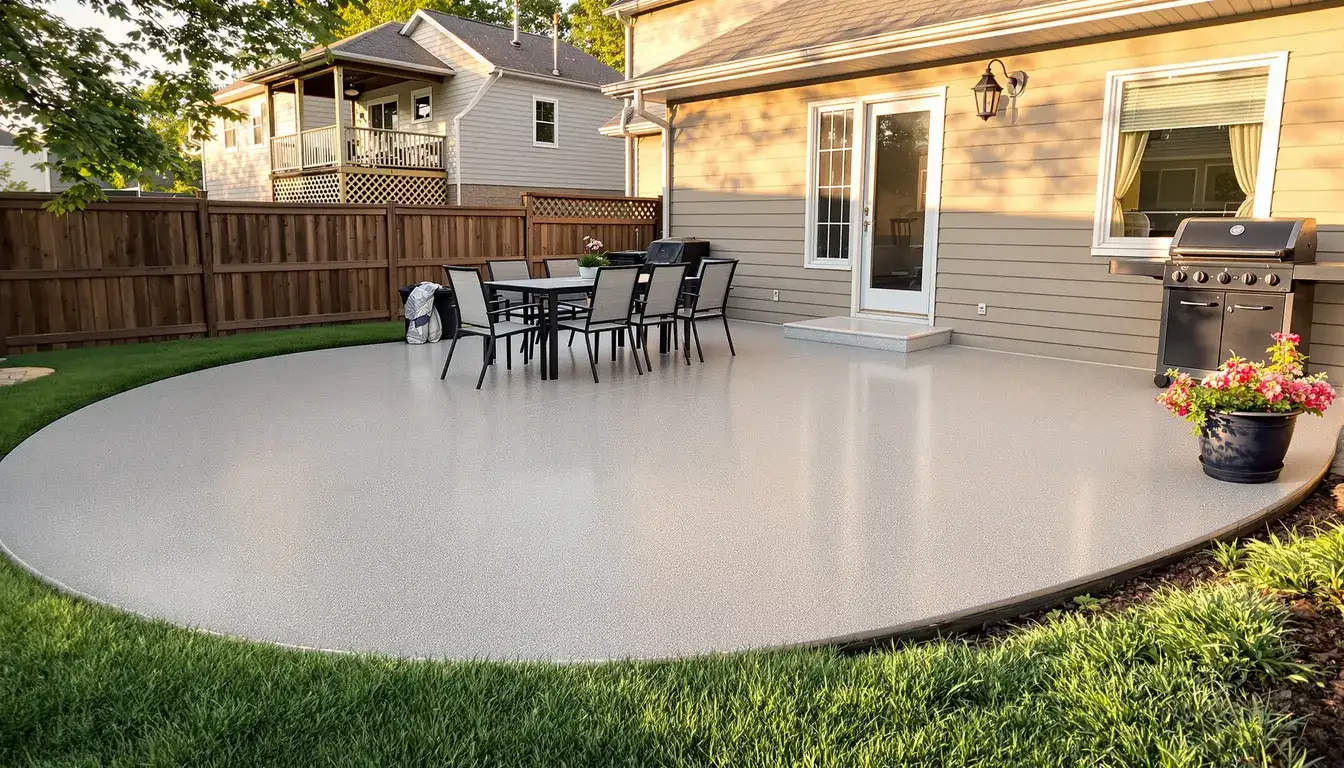
Concrete Patios & Outdoor Spaces in Tonganoxie, KS
Concrete patios for Tonganoxie's rural lots — turning a gravel or dirt spot into a poured patio on Leavenworth County loess, off US-24/40 and the historic Main Street core
Concrete Patios & Outdoor Spaces in Tonganoxie
Custom concrete patio design and installation for backyards, outdoor living areas, and commercial courtyards. Ford Concrete serves Tonganoxie, KS and the entire Kansas City metro with more than a decade of experience and a 5-star reputation.
Tonganoxie at a Glance
- Population
- 5,742
- State
- Kansas
- County
- Leavenworth County
- Schools
- Tonganoxie USD 464
Turning a gravel spot into a poured patio in Tonganoxie
A concrete patio in Tonganoxie starts with the ground under it. Out here that's often a gravel or dirt spot behind a farmhouse or an acreage home, sitting over Leavenworth County loess — a wind-laid silt that stays firm while it's dry and gives way once it soaks. We strip that spot, rebuild it as a compacted base the loess can't pull down, and pour a slab that reads as part of the property.
Tonganoxie has grown from a farm town into an industrial stop on US-24/40, but most back yards here are still generous rural lots where a real patio takes the place of a gravel patch that turns to mud every spring. Making that swap is its own job: the loose stone has to come out, the loess underneath has to be read and rebuilt, and the grade has to carry water clear before any concrete goes down. If a slab you already have is only worn on top, our resurfacing may be all it needs.
A base the Tonganoxie loess can't pull down
Loess behaves unlike clay: it doesn't swell and lift, it loses its footing and drops when it gets wet. So the base is built to keep that silt from ever taking on water and to bridge it if a soft spot shows up. We dig past the old gravel and any topsoil, then rebuild a compacted base in thin lifts so it carries the slab evenly, and we hold a restraint point around the perimeter so a heavy pad can't creep outward if the loess softens at an edge.
The patio comes off the house on an isolation joint so the two move on their own, and on a wide rural pour we run doweled joints so load hands across the joint rather than one panel settling below the next. The slab goes down at 4,000 PSI — the same mix and crew behind heavy commercial flatwork out at the Tonganoxie Business Park, sized here for a backyard on farm ground.
Because dry loess is strong loess, the base is also a moisture barrier: an open, free-draining layer under the slab keeps groundwater and runoff from wicking up into the silt. Keep the loess dry and the ground under a Chieftain Estates patio holds as firm through a wet April as it does in a dry September.
Keeping water off loess on an open rural lot
On loess, water is the one thing that undoes a patio, and rural lots give it plenty of room to gather — so the whole slab is shaped to move rain off and away. We set the threshold elevation a full step below the door and pitch the surface toward the yard, so a hard rain runs off the pad instead of pooling against the wall or soaking into the silt.
The fall we cut is a steady quarter inch to the foot of positive drainage, worked into the subgrade from the doorway out before the pour — never faked afterward with a surface channel. Since loess surrenders its strength the moment it's saturated, getting that water gone fast is most of what keeps a patio here level for good.
On an acreage lot the roof is a bigger factor than people expect. A downspout that dumps beside the slab drives a concentrated soak straight into ground that can least handle it, so we lay the grade out around where your gutters actually let go and carry that water well clear of the pad rather than into the base.
Where a loess patio cracks around here
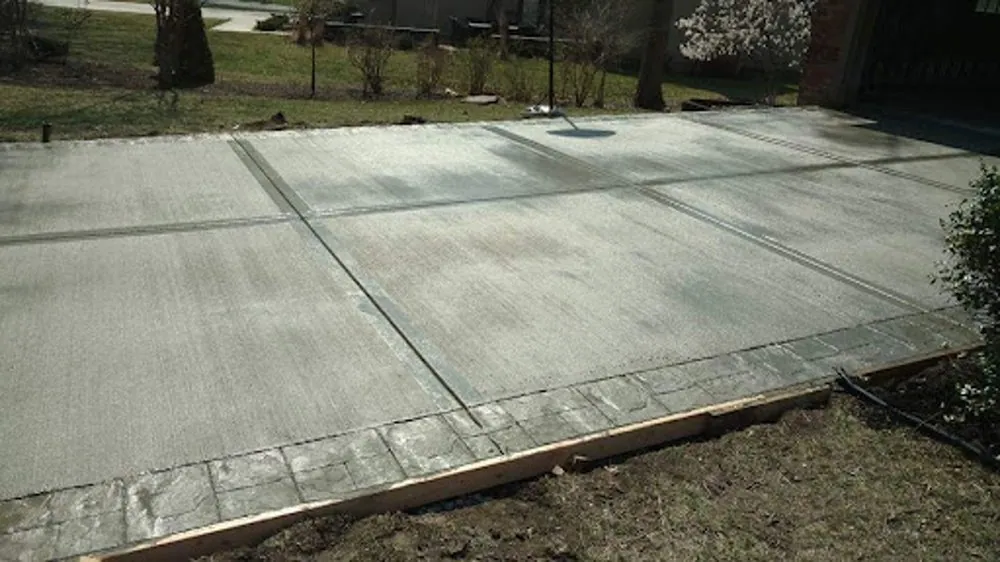
Loess settles rather than heaves, so the cracking here comes from the slab dropping unevenly — and joints are how we keep that from tearing the field apart. We cut contraction joints on a roughly ten-foot grid so each section can settle on its own instead of the middle splitting.
The spot that gets the most care is the re-entrant corner — the inside angle at a step or an L-shaped edge — where a slab pulled two directions wants to crack first. Cuts go about a quarter of the slab's depth, so when the ground gives a little the crack forms clean at the base of the groove rather than wandering across the top.
On silt that can drop where it wets unevenly, we reinforce the slab with fiber or rebar so it spans a soft pocket in one piece instead of breaking over it. Done right, all of that shows up as tooled lines you'll hardly notice, not damage.
Broom or stamped for a Chieftain Estates back yard
A home out on Laming Road or in Chieftain Estates usually wants a patio that suits the property rather than a plain gray pad. The choice comes down to the surface: a broom vs stamped finish is what most owners weigh. A broomed top gives an even, non-slick texture that takes a family and a smoker well; stamped concrete presses stone, brick, or plank relief into the pour for something closer to a paved room off the house. We settle it with a mockup — a small test panel poured on your own lot so you judge color and texture in the light it'll live in.
Loess ground wants a fair number of joints, so we lay them out as part of the look rather than fight them. Joint pattern continuity keeps the sawn lines squared to the house wall, the posts, and any stamp seams, so a well-jointed slab still reads as one planned surface. Our gallery shows how the colors and textures land in finished yards.
Every finish is sealed with an eye to its sealer vapor transmission, so any moisture rising off the ground can pass out through the slab instead of lifting the coating from beneath; a light reseal every couple of seasons keeps a stamped relief sharp through the freeze-thaw of a Kansas winter.
Replacing an old slab in the historic core
Not every Tonganoxie patio sits on a fresh rural lot. In the Historic District and along Main and 4th Streets, slabs poured fifty-plus years back went in thin and with no contraction joint to steer the cracking, and a lifetime of loess settlement has left many split and out of level.
What settles resurfacing versus replacement is the state of the concrete beneath the wear. A worn top over a sound slab can take a resurfacing and buy years; a corner that's dropped where the silt gave out has a base problem, and only a new slab on a rebuilt base cures that. We'll walk yours on site and tell you plainly — and when the old concrete has to come out either way, it's the chance to grow the patio or fix a cramped, awkward shape.
A slab sunk on one side turns its joint into a toe-catch, and that trip risk is usually what moves an owner from patching to replacing. We quote both so you can decide on real numbers.
Do you need a permit for a patio in Tonganoxie?
Patio permitting in Tonganoxie runs through the City of Tonganoxie inside the limits and Leavenworth County out on the rural lots, and a covered or attached patio gets a harder look than a slab on grade. We pull the right permit for where you sit, keep the pour off your setbacks and utility easements, build to Leavenworth County and KDHE standards, and set the threshold elevation so runoff stays on your ground. On a rural parcel with a long county-road frontage, the easement lines aren't obvious from the yard, so we check the recorded plat before we form rather than after.
We cover the northwest edge of the metro, so whether your lot is here in Tonganoxie, over in Basehor, north in Leavenworth, or south toward Lawrence, we build the base to the ground you've got — and rural loess is its own job. Start on the main concrete patio page to see how we work.
Ready to build your Tonganoxie patio?
From call to concrete — the fastest in KC.
Whether it's a gravel spot behind a farmhouse or an old slab downtown, a patio here holds only when the base is built for Tonganoxie's loess. Ford reads the ground, does the work, and hands you a written price instead of a guess. Call (816) 721-1699 to set up a site visit.
What goes into a Tonganoxie Concrete Patios & Outdoor Spaces job
Read the ground and the gravel
We check how deep the old stone and topsoil run and how the loess below behaves wet, then match the base plan to your Tonganoxie lot before we price it.
Mark the shape and the fall
We stake the footprint and joint grid and drop the threshold below the door so water always sheds toward the yard, not the wall.
Strip out and rebuild the base
We haul off the loose gravel and soft soil, then rebuild a compacted base in thin lifts with a free-draining layer that keeps the loess from taking on water.
Form, pitch, and lock the edge
We set the forms, cut the drainage fall, and anchor the restraint point around the perimeter so nothing spreads once the slab is on the silt.
Place the 4,000-PSI slab
We pour and screed a 4,000-PSI mix, float it, and lay in the broom or stamp texture you approved on the mockup.
Saw the joints on time
We time the contraction-joint cuts to the pour so the slab relieves along our lines instead of wherever the loess decides to settle.
Seal, cure, and hand it off
We cure and seal the patio, then walk it with you and explain how the loess under it was handled so it stays put.
When Concrete Patios & Outdoor Spaces in Tonganoxie is ready to replace
A slab that's dropped, not lifted
A patio that's sunk on one side rather than pushed up is the signature of loess settling — the silt lost strength where it got wet and let the slab down with it.
A crack out of an inside angle
A crack running from an inside corner means the slab is splitting where it's pulled two ways, a spot that gives out first when loess settles unevenly beneath it.
Mud where the gravel used to be
A gravel spot that turns soupy every spring is loess taking on water it can't shed — the same ground a poured slab has to be built to keep dry.
A face shedding sand
A top that sheds sand and grit points to an overworked finish or a slab held damp from below — a common story on Tonganoxie's old jointless downtown pours.
A separating edge at the house
A gap opening where the slab meets the wall means the patio was poured tight to the house with no isolation joint, so its own settling is prying the two apart.
A hollow spot underfoot
Give or a hollow ring near an edge says the ground beneath has washed out, usually where water carried the loess away and left the concrete bridging air.
Why Tonganoxie homeowners call Ford
Gravel to patio in one job
We strip the old stone, read and rebuild the loess under it, and pour the slab — the whole conversion handled by one crew so nothing gets skipped between steps.
An easy run out US-24/40
Tonganoxie sits on US-24/40 in Leavenworth County, a short trip for us to walk your lot, sort the permit, and get it poured.
Commercial flatwork at home
The crew that screeds large commercial floors out at the business parks brings the same flat, tight-jointed pour to a Tonganoxie back yard.
29 reviews, 4.9 stars
Ford Concrete keeps a 4.9-star average across 29 Google reviews from homeowners around the metro.
Proof we pour at any scale
From your driveway to an Amazon warehouse — the same crew, the same standards, every project.
Taco Bell
New Construction
Overland Park, KS
Domino's Pizza
New Construction
Independence, MO
Freddy's
New Construction
Kansas City
Tidal Wave Car Wash
New Construction
Kansas City
Amazon
New Construction
Riverside, MO
Nortian Food Grade Protein Facility
New Construction
Springfield, MO
Price your Tonganoxie Concrete Patios & Outdoor Spaces project
Or call us directly: (816) 721-1699
Concrete Patios & Outdoor Spaces in Tonganoxie — FAQs
Can you turn my gravel patio area into concrete?
Why does loess make a patio harder to build on?
Do I need a permit for a patio in Tonganoxie?
How long does a patio take to build in Tonganoxie?
Will the patio crack as the ground settles?
Can you make the patio bigger when you replace an old one?
Related concrete services in Tonganoxie
Where else we pour near Tonganoxie
Start your Tonganoxie concrete project
From call to concrete — the fastest in KC.
Get a free, no-obligation estimate for your concrete project. We serve the entire Kansas City metro — call (816) 721-1699 or request your estimate online.