Concrete Repair in Lawrence, KS
Concrete repair for Lawrence — from the Kaw River bottoms to the clay up on Mount Oread, matched to the ground you actually have
Concrete Repair in Lawrence
Concrete crack repair, spalling repair, joint sealing, and structural restoration for all concrete surfaces. Ford Concrete serves Lawrence, KS and the entire Kansas City metro with more than a decade of experience and a 5-star reputation.
Lawrence at a Glance
- Population
- 97,411
- State
- Kansas
- County
- Douglas County
- Schools
- Lawrence Public Schools (USD 497)
In Lawrence, is your slab heaving or settling?
A heaved slab and a settled slab in Lawrence can look identical — one corner out of level, a cracked panel — but they fail for opposite reasons and need opposite repairs. Which one you have depends on where you are: the Kaw River bottoms lift and the clay up on Mount Oread drops. We diagnose the direction first — sounding the slab to read the ground — then fix it.
Get that call wrong and the repair fails fast: relevel a slab that is actually being pushed up by moisture and it heaves again; lift a settled slab without filling the void beneath it and it drops right back. Our concrete repair work in Douglas County starts by reading the ground, not the crack.
Two grounds under Lawrence, two kinds of failure
Down in the Kaw and Wakarusa bottoms — the low ground near the river and the valley areas — slabs sit on alluvial soil with a high water table. Saturated ground and a shallow frost line push concrete up, so bottom-land slabs tend to heave. Repairing them means relieving the moisture and, where a panel has lifted, resetting it to grade rather than chasing the crack.
Up on Mount Oread and through Old West Lawrence, the ground is upland clay that shrinks in drought and swells in wet spells. Those slabs crack from shrink-swell and settle as the clay dries, so the fix is filling the void and restoring support. Same city, opposite repair — which is why we never quote before we know which ground you are on.
Reading a Lawrence crack: active or dormant
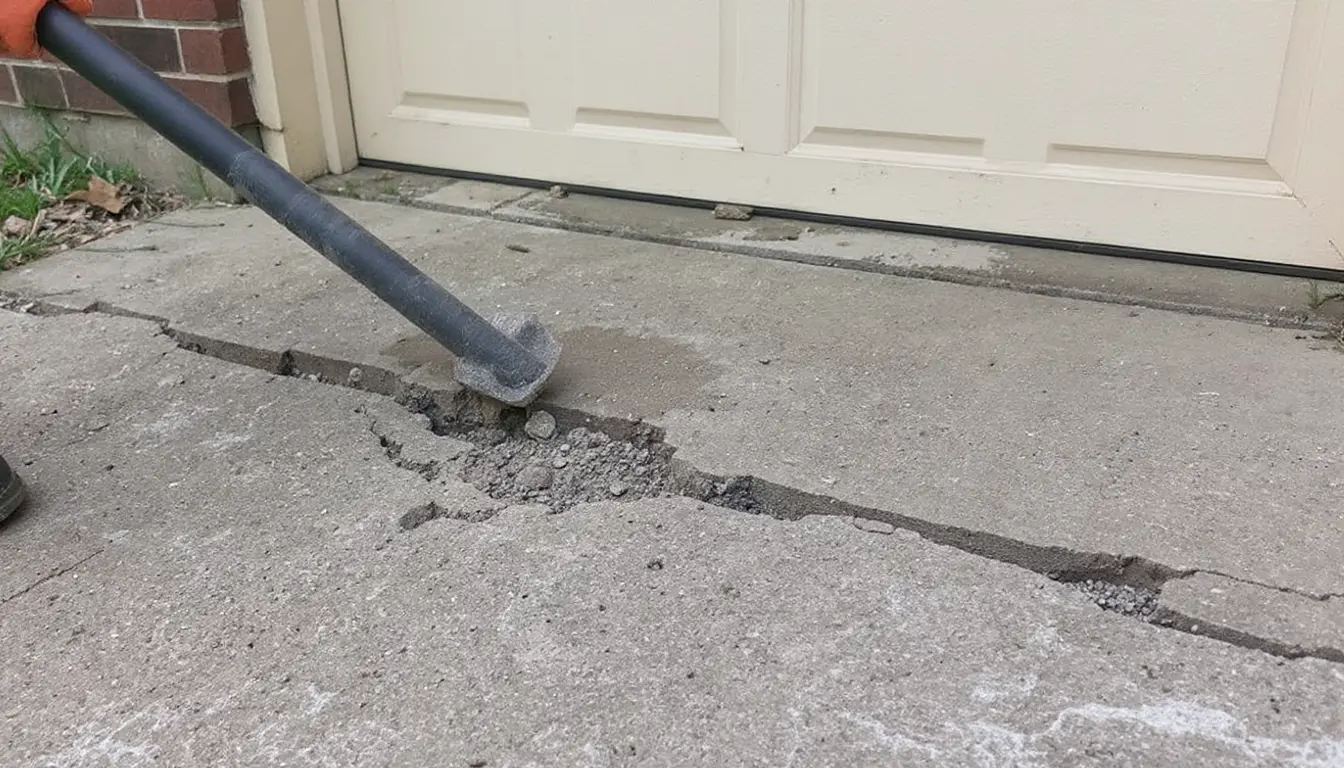
On either ground, we classify every crack as an active crack, still opening and closing with the seasons, or a dormant crack that has stopped moving — and the classification, not the width, drives the repair. A hairline that keeps reopening tells us more than a wide crack that has held still for years.
A dormant crack in a stable panel takes a rigid structural repair that restores load across the break. An active crack over moving clay or a lifting bottom needs a flexible detail, or it simply reappears beside the fill. A crack that has come back after a previous patch is active by definition, and we treat it that way.
Alligator cracking on the South Iowa retail strip
The commercial lots along South Iowa Street and 23rd Street date to the 1980s and 90s, and many have reached the point where the surface is broken into a tight web — alligator cracking. On a driveway that can be cosmetic, but on a high-volume retail lot it usually means the base below has failed under years of commuter and delivery load. A surface repair there is money wasted.
We core or probe to confirm whether the base is sound before recommending anything. Where the subgrade still bears, we do full-depth panel replacement and restore load transfer; where it has broken down across the lot, we say so and price a proper rebuild. That honest split is what property owners and general contractors around KU and the South Iowa district call us back for.
How the repair is built to hold
Once the direction is known, the method is disciplined. We saw a clean perimeter, remove material to sound substrate, and abrade to an ICRI CSP profile so the new concrete keys in. The slab reaches saturated surface-dry, and full-depth breaks get load transfer restored across the joint.
We never feather-edge a patch to a thin, unsupported border — it flakes off in a season on any ground. Repairs go back at 4,000 PSI, air-entrained for the freeze-thaw cycling Douglas County sees each winter, and cured so the surface reaches strength before the cold sets in.
Scaling and spalling through a Kansas winter
Surface scaling that sheets the top layer off is freeze-thaw and deicer damage — common on walks and steps around campus and downtown after a hard winter. On a sound slab it is repairable with a bonded resurfacing overlay instead of a teardown.
Ignored, scaling lets chloride reach the steel, corrosion starts, and the slab breaks apart as spalling at joints and edges. Where we find exposed reinforcement, the repair means removing concrete to sound material behind the bar and cleaning the steel first. See finished work in our gallery, or compare nearby repairs in Eudora and Tonganoxie.
What concrete repair costs in Lawrence — and when to replace
We price from the cause, not the crack, so the number follows a real look at the slab and the ground under it — never a phone quote. Resetting a single heaved panel or filling one void is inexpensive; a lot where the base has failed across the surface costs more but buys years. When settlement or corrosion has run through most of a slab, replacement wins over a decade, and we tell you plainly.
You get a written figure and a clear repair-or-replace call. Structural and right-of-way work runs through the City of Lawrence, with stormwater following KDHE practice; our soil-conditions guide explains how the two grounds behave. Lawrence property owners are part of the 4.9-star record across 29 reviews we have built on straight answers.
Not sure if your Lawrence slab is heaving or settling?
From call to concrete — the fastest in KC.
That is the first thing we figure out — and it decides the whole repair. We read the ground, find the cause, and hand you a written repair-or-replace answer, usually within 24 hours. Call (816) 721-1699.
How we pour Concrete Repair in Lawrence
Diagnose heave or settle
We read the ground, check the water table and grade, and determine whether the slab is lifting or dropping before anything else.
Confirm the base
We probe or core to see whether the subgrade still bears, and classify each crack active or dormant.
Remove and prep to bond
Deteriorated material is saw-cut to sound substrate and abraded to an ICRI profile — no feather-edges, no patching over rust.
Place, transfer load, and cure
We repair partial- or full-depth at 4,000 PSI, air-entrained for Douglas County winters, restore load transfer, and cure the work.
Warning signs on Lawrence Concrete Repair
A slab corner pushed up out of level
In the river bottoms, a high water table and frost heave lift concrete — the fix relieves moisture and resets to grade.
A settled slab up on the clay
On Mount Oread's upland clay, shrink-swell drops slabs as the ground dries — the void has to be filled and support restored.
A tight web of cracks on a retail lot
Alligator cracking on South Iowa lots usually means the base has failed under years of load, not a surface problem.
A crack that keeps coming back
A crack reopening after every patch is active, moving with the season, and needs a flexible detail.
Surface flaking after winter
Scaling on walks and steps is freeze-thaw and deicer damage — repairable on a sound slab with a bonded overlay.
How Ford earns Lawrence work
Heave or settle — we know the difference
The two look alike but need opposite repairs. We diagnose the direction before we quote a number.
We read the ground first
Kaw bottoms lift, Mount Oread clay drops. The right fix depends on which Lawrence you're in.
Base checked before any surface work
On South Iowa lots, alligator cracking usually means the base failed. We confirm before recommending a repair.
A straight repair-or-replace answer
You get a written figure and an honest call. Part of a 4.9-star record across 29 reviews.
The projects behind our name
From your driveway to an Amazon warehouse — the same crew, the same standards, every project.
Taco Bell
New Construction
Overland Park, KS
Domino's Pizza
New Construction
Independence, MO
Freddy's
New Construction
Kansas City
Tidal Wave Car Wash
New Construction
Kansas City
Amazon
New Construction
Riverside, MO
Nortian Food Grade Protein Facility
New Construction
Springfield, MO
Start with a free Lawrence estimate
Or call us directly: (816) 721-1699
Concrete Repair in Lawrence — FAQs
How do you tell if my slab is heaving or settling?
My retail lot is cracked all over in a tight pattern — surface or base?
Why do my cracks keep coming back after patching?
Can scaling and spalling be repaired, or does the slab have to go?
Do I need a permit to repair concrete in Lawrence?
Related concrete services in Lawrence
Lawrence and neighboring communities
Get your Lawrence project moving
From call to concrete — the fastest in KC.
Get a free, no-obligation estimate for your concrete project. We serve the entire Kansas City metro — call (816) 721-1699 or request your estimate online.