
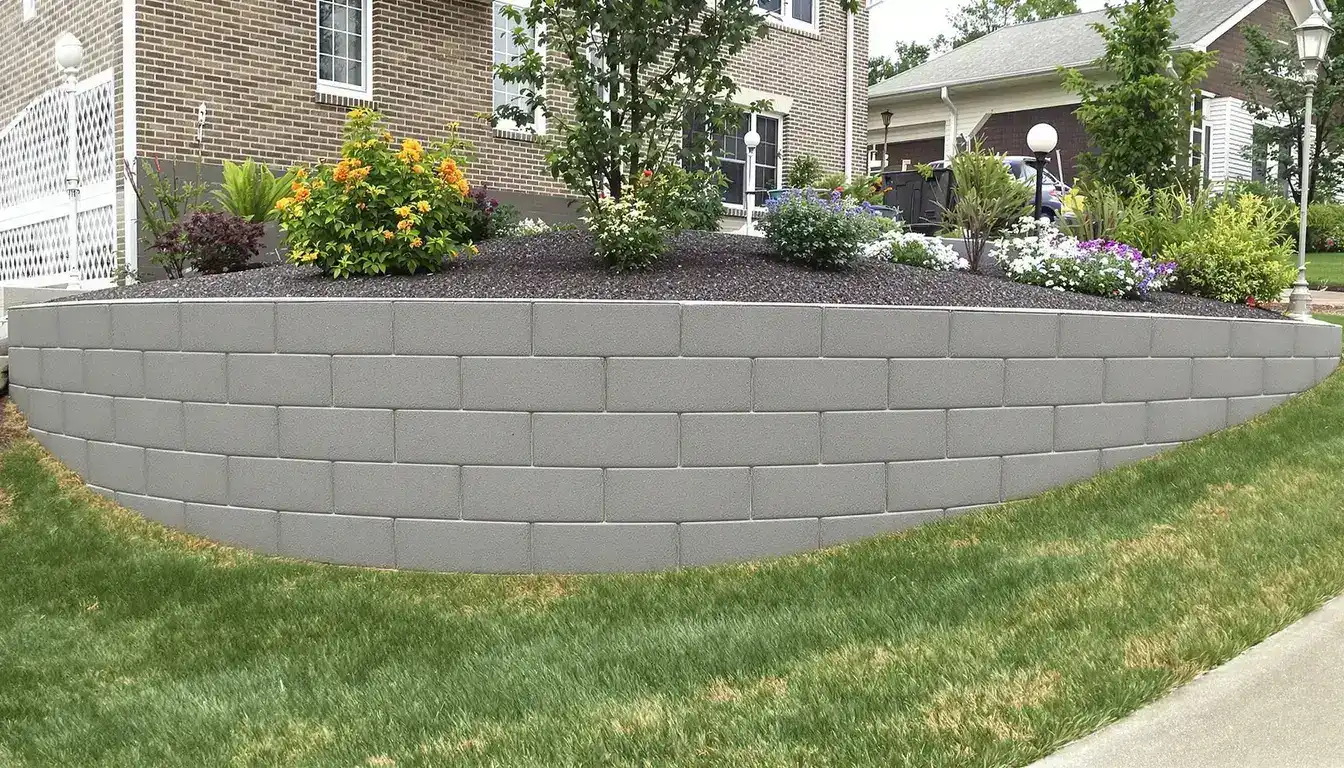
Retaining Walls in Spring Hill, KS
Engineered concrete retaining walls for Spring Hill — founded through graded builder's fill to the shallow limestone under southern Johnson County, and drained to shed perched water
Retaining Walls in Spring Hill
Structural and decorative concrete retaining wall construction for erosion control, landscaping, and property grading. Ford Concrete serves Spring Hill, KS and the entire Kansas City metro with more than a decade of experience and a 5-star reputation.
Spring Hill at a Glance
- Population
- 10,200
- State
- Kansas
- County
- Johnson County
- Schools
- Spring Hill USD 230
What does a retaining wall stand on in a new Spring Hill subdivision?
A retaining wall in Spring Hill holds when its footing reaches firm bearing — not the loose pad fill a builder graded across a new lot — its stem is sized for the lateral earth pressure behind it, and the water above the shallow limestone is drained off. On the county-line subdivisions, that first point decides the wall.
Spring Hill has grown fast from a farm town into a suburban hub, and the newest lots off US-169 near Woodland Reserve and Eagles Landing were graded and filled before a house went up. Under that fill, southern Johnson County's native limestone sits within a few feet of the surface. A concrete retaining wall here has to be founded through the placed fill to that firm ground.
New lots, graded fill, and the limestone underneath
The catch on a new Spring Hill lot is that the ground behind and beneath your wall may not be native. To level a sloping subdivision, builders cut high spots and fill low ones, and pad fill compacted for a house pad is not always ready to carry a wall footing. We check what the base bears on and dig through soft or disturbed fill until the footing sits on firm ground or the limestone bench below it — the same firm bearing that keeps the wall from settling unevenly. The rock-shelf ground here is the same one we build on in Gardner and Olathe.
Where the rock is shallow, we bear or key the footing into it and set the base below the roughly 36-inch frost line. That is what stops the heaving that shows up across Spring Hill's residential-commercial transition zones, where slabs and walls placed on untested fill lift and crack.
Draining a wall where the water can't sink
Limestone close to the surface does not let water pass, so rain that soaks the backfill perches on the rock and builds hydrostatic pressure against the back of the wall. A wall sized only for soil gets shoved when that water has nowhere to go. Every wall we build gets a drainage column — clean drainage aggregate against the back face, a perforated drain at the footing wrapped in filter fabric so it will not silt shut, and weep outlets that let the water leave.
On Spring Hill's rolling ground toward Hedge Lane Reservoir and Sycamore Ridge, that drainage layer is what keeps a wall standing through a wet spring. Our storm drainage work and the Kansas City soil guide cover how we route water away from structures.
Do you need a permit for a retaining wall in Spring Hill?
Spring Hill straddles two counties, so which office reviews your wall can depend on which side of the line the lot falls on, and the city reviews walls inside its limits. As a rule across the metro, a wall over four feet — measured from the bottom of the footing — needs an engineered design and a permit, and any wall holding a surcharge like a driveway or a structure above it should be engineered whatever its height. We build to the stamped design and pull the permit before the first cut, the way we do for Paola and Louisburg property owners just down US-169.
Ford has placed concrete for KC-metro homeowners for over a decade, and Spring Hill property owners get the same engineered base, drainage, and reinforcement we build on every wall. Call (816) 721-1699 for a site evaluation, and see finished work in our gallery.
Planning a retaining wall in Spring Hill?
From call to concrete — the fastest in KC.
On a new county-line lot, a wall is only as good as the ground its footing reaches. Ford digs to firm bearing, drains the rock shelf, and builds to an engineered design. Call (816) 721-1699 for a site evaluation.
How we pour Retaining Walls in Spring Hill
Read the grade and the fill
We measure the grade change, note any surcharge above, and check what the builder's fill sits on.
Find firm bearing
We dig through soft or disturbed fill to firm ground or the limestone bench below the frost line.
Set the base
We form and pour the footing, sized to the wall height and the load behind it.
Build the drainage column
Drainage aggregate, a perforated drain in filter fabric, and weep outlets go in behind the wall.
Place and reinforce the stem
We pour the reinforced stem and tie it to the footing so the wall resists the push.
Backfill in lifts
We compact the backfill in lifts, not loose, so the ground behind the wall carries its share.
Warning signs on Spring Hill Retaining Walls
A wall leaning outward
A wall tilting at the top usually means the footing is undersized or the backfill is loaded with surcharge it was never designed to hold.
Water weeping through the face
Water coming through the wall means the drainage column behind it has silted or was never built — hydrostatic pressure is finding its own way out.
Cracks stair-stepping across the face
Diagonal cracking often follows uneven settlement where the footing bears on soft pad fill instead of firm ground.
Soil or mulch washing out below
Backfill escaping under the wall points to a base built without a compacted footing on firm bearing.
How Ford earns Spring Hill work
Founded through the fill
On new subdivision lots we dig through graded builder's fill to firm ground or the limestone bench, so the footing bears on ground that won't settle.
Drained for the rock shelf
Water can't sink through shallow limestone, so every wall gets drainage aggregate, a perforated drain in filter fabric, and weep outlets to carry perched water off.
Sized for the load above
A wall holding a driveway, a slope, or a structure carries surcharge — we size the footing and stem to the real load, not a guess.
Engineered and permitted
Walls over four feet get a stamped engineered design and a permit, and we build to it — county line or city limits, we pull the right one.
The projects behind our name
From your driveway to an Amazon warehouse — the same crew, the same standards, every project.
Taco Bell
New Construction
Overland Park, KS
Domino's Pizza
New Construction
Independence, MO
Freddy's
New Construction
Kansas City
Tidal Wave Car Wash
New Construction
Kansas City
Amazon
New Construction
Riverside, MO
Nortian Food Grade Protein Facility
New Construction
Springfield, MO
Start with a free Spring Hill estimate
Or call us directly: (816) 721-1699
Retaining Walls in Spring Hill — FAQs
Why does a retaining wall on a new Spring Hill lot need extra attention?
How deep does the footing have to go?
Do I need a permit for a retaining wall in Spring Hill?
More Spring Hill concrete services
Serving Spring Hill and the surrounding metro
Get your Spring Hill project moving
From call to concrete — the fastest in KC.
Get a free, no-obligation estimate for your concrete project. We serve the entire Kansas City metro — call (816) 721-1699 or request your estimate online.